Why do injections and tablets work differently?
Quick answer
Many peptide medicines are injected because digestive enzymes can break them down and the gut may absorb them poorly; injection allows the medicine to enter the body by a different route. Some peptides have specially formulated oral versions, so the route and dose are medicine-specific and should not be interchanged without medical advice.
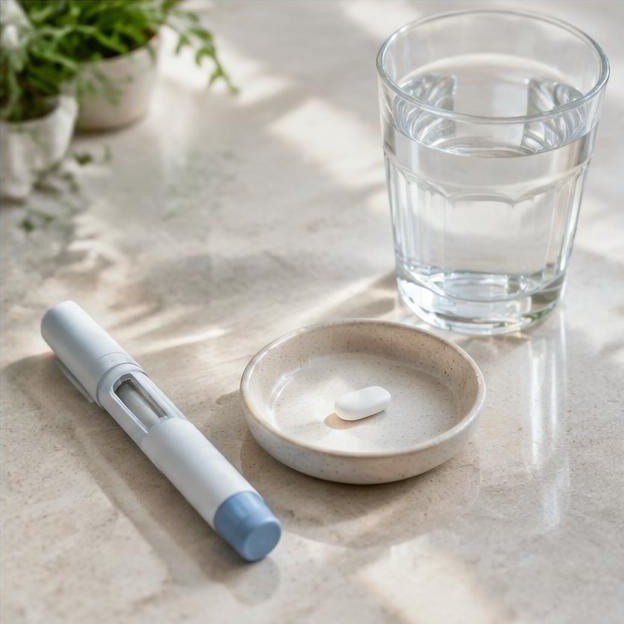
Injections and tablets differ in how a medicine reaches your bloodstream, but the route does not always change how it works. Semaglutide, for example, can be injected or taken orally and still targets the same hormone receptor. The formulation, licensed use and dosing instructions matter more than a simple injection-versus-tablet distinction.
What is a peptide medicine?
Peptides are chains of amino acids, the building blocks of proteins. Semaglutide, liraglutide and tirzepatide are peptide-based medicines designed to act on hormone receptors. A receptor is a protein that receives a chemical signal. Their effects depend on the receptors they target, not simply on whether they are swallowed or injected.
Semaglutide and liraglutide act on the glucagon-like peptide-1 (GLP-1) receptor. Tirzepatide also acts on the glucose-dependent insulinotropic polypeptide (GIP) receptor. These signals influence appetite and glucose regulation.
Why are many peptide medicines injected?
The digestive system normally breaks down proteins and peptides, and the gut lining limits how much passes into the bloodstream. An injection under the skin, called a subcutaneous injection, avoids that digestive barrier. The medicine's design also affects how long it lasts: some injectable products are daily, others weekly. An injection is not automatically stronger, safer or more effective than a tablet.
How can semaglutide also be a tablet?
Special oral formulations include an absorption-enhancing ingredient that helps semaglutide cross the stomach lining. Oral and injected semaglutide still act at the GLP-1 receptor, although absorption and dosing are different.
In the UK, Rybelsus is a semaglutide tablet for type 2 diabetes. Wegovy tablets are licensed for adult weight management; Wegovy also has injectable formulations. A licence does not establish local stock or NHS access. Product names, strengths and indications must be checked rather than assuming every semaglutide tablet is the same.
Oral semaglutide needs an empty stomach and a specified interval before food, drink or other tablets. Follow the leaflet for the exact product. Do not crush or split it unless its instructions explicitly allow this. If your routine or other medicines make the timing difficult, ask a pharmacist for help.
Do other weight-management tablets work differently?
Some do. Orlistat, for example, reduces absorption of some dietary fat by inhibiting digestive enzymes. That is different from acting on GLP-1 receptors. But it would be incorrect to say that all tablets work in the gut while all injections work in the brain: the medicine's molecular target and formulation determine its effects.
Choose treatment with a prescriber based on the licensed indication, medical history, other medicines, likely side effects and practical preferences. Needle anxiety and difficulty swallowing or following fasting instructions are valid things to discuss.
Can you swap a tablet for an injection yourself?
No. Milligram doses are not equivalent across routes or brands. Changing formulation needs a prescribed transition plan; do not overlap supplies or combine GLP-1 medicines. Learn the instructions for your actual device, including needle use, storage and disposal. Never share an injection pen.
Sources & further reading

Reviewed by
Dr Chinnadorai Rajeswaran
Specialist Endocrinologist · MBBS MRCP FRCP
Last Reviewed: November 2026
Read about medication and related care.
Related insights

Weight Regain After GLP-1 Treatment: Why It Happens
Weight regain after stopping GLP-1 treatment is common because appetite and weight-regulating biology persist, though individual responses differ. Discuss a long-term plan with the prescriber before stopping or restarting, and do not alter doses independently.
Foundayo (Orforglipron): What a Daily Tablet Changes
Foundayo is a once-daily orforglipron tablet licensed in the UK, offering an oral route without the fasting routine required for oral semaglutide. Taking a tablet rather than an injection does not remove the need for a doctor to assess suitability, monitor side effects and review ongoing treatment.
Oral or Injectable GLP-1: How We Choose a Route
Oral and injectable GLP-1 medicines differ in absorption, dosing, evidence, and practical considerations; neither route is automatically best for everyone. A prescriber should choose based on the specific product, medical history, preferences, and local approval, with instructions followed exactly.