Male Breast Tissue: When It Is Hormonal and When It Is Not
Quick answer
Enlarged male breasts may be glandular tissue (gynaecomastia), fat (pseudogynaecomastia) or both, and glandular change is common in puberty and later life but can also reflect medicines, liver or kidney disease, an overactive thyroid, or low testosterone. Ask for examination rather than assuming it is only weight, because weight loss reduces fat and not glandular tissue. See a GP promptly for a one-sided firm or fixed lump, nipple discharge or retraction, or skin change, which need assessment for breast cancer.
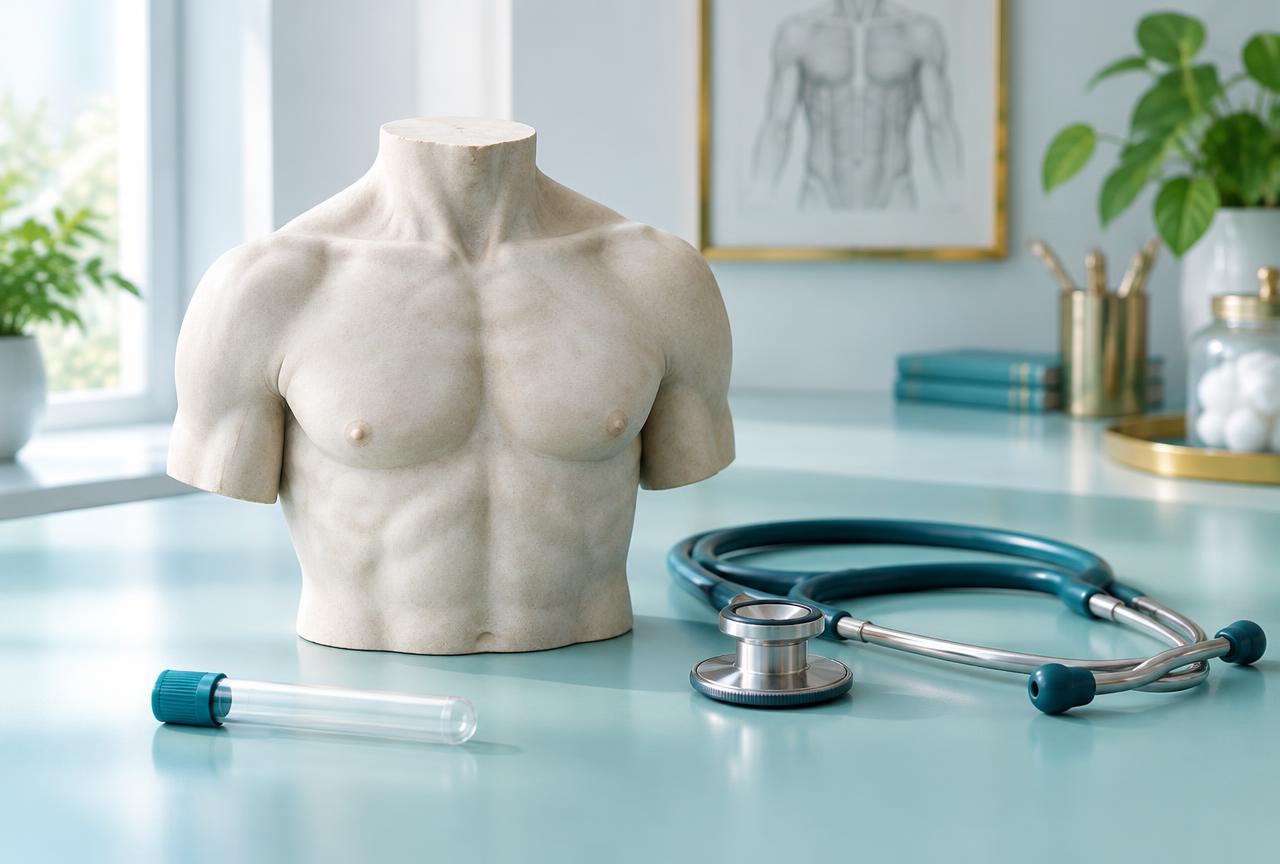
Enlarged male breasts are common, rarely discussed, and the two facts are related. Men often arrive at a consultation having avoided the subject for years, having changed how they dress or swim, and having assumed it was simply a consequence of being overweight. Sometimes it is. Often it is not, and the distinction matters because the treatments differ.
Gynaecomastia means enlargement of the glandular breast tissue in men, defined clinically as palpable breast tissue beneath the areola, conventionally 2 cm or more across. Pseudogynaecomastia, sometimes called lipomastia, is enlargement from fat alone, with no increase in glandular tissue. The two feel different on examination, which is why examination is worth more here than any description.
Reassurance is largely justified. European andrology guidance describes gynaecomastia as a benign enlargement of glandular tissue, with reported prevalence between roughly a third and two-thirds of men depending on the population studied. A small number of features do need prompt attention, and those are set out below.
Glandular tissue and fat are not the same thing
Glandular gynaecomastia is usually felt as a firm or rubbery disc of tissue centred on the nipple, often tender, and sometimes clearly bounded against the softer surrounding fat. Pseudogynaecomastia feels diffuse and soft, with no discrete subareolar disc.
Both can be present together, and in men with a higher BMI they commonly are. In one published review of hospitalised men aged 58 to 71, the prevalence of palpable breast tissue was around 65 per cent, rising to roughly 80 per cent in those with a BMI of 25 or above. It rises with both age and weight.
The oestrogen-to-androgen balance
Breast tissue responds to both oestrogens and androgens, and glandular growth follows a relative shift in favour of oestrogen rather than any single absolute hormone level. That shift can arise from reduced androgen production, increased oestrogen production, increased conversion of one to the other, or displacement from binding proteins.
Adipose tissue is relevant because it converts androgens into oestrogens. Work going back to the 1970s showed that human abdominal, breast and axillary fat aromatises androstenedione and testosterone into oestrone and oestradiol, and concluded that fat may be a significant extragonadal source of oestrogens. That is a plausible contribution in men carrying more fat, but it is one mechanism among several rather than the whole explanation.
When it is expected rather than abnormal
Glandular breast tissue is physiological at several points in life. The NHS notes it in newborns, where maternal pregnancy hormones are responsible, during puberty, and in men over 50 as hormone levels change. In newborns and in puberty it usually resolves without treatment.
Causes worth looking for
Medicines are the group most often blamed and the group where evidence quality varies most. A critical review found that for many commonly cited drugs the association is poorly documented, with hormone profiles usually within reference ranges. Where UK product information is explicit, the evidence is firmer:
- Bicalutamide, an anti-androgen used in prostate cancer, lists gynaecomastia and breast tenderness as very common at the 150 mg monotherapy dose, with the majority of men affected, and notes it may not resolve after stopping, particularly after prolonged treatment.
- Spironolactone lists gynaecomastia and male breast pain as common, states that development appears related to both dose and duration, and that it is normally reversible on stopping, though rarely some enlargement persists.
- Finasteride lists breast tenderness and enlargement at an unquantified frequency, and instructs patients to report promptly any change in breast tissue such as lumps, pain, gynaecomastia or nipple discharge, because male breast cancer has been reported after marketing.
- Anabolic steroids are a recognised cause: the NHS lists breast development alongside reduced sperm count, shrunken testicles and infertility among their effects in men.
Beyond medicines, the NHS lists an overactive thyroid, kidney disease and cirrhosis among the conditions responsible. Hypogonadism from any cause shifts the same balance. Rarely a hormone-producing tumour is found, which is why European guidance includes examination of the testes and, where indicated, testicular ultrasound in the work-up. NICE separately advises considering referral for suspected testicular cancer where there is non-painful enlargement or a change in the shape or texture of a testis.
Features that warrant prompt assessment
Gynaecomastia itself is not a cancer referral trigger in NICE guidance and should not be treated as one. Breast cancer in men is uncommon but it does occur, and the NICE suspected cancer recommendations are written for people rather than for women only:
- An unexplained breast lump, with or without pain, at age 30 or over warrants a suspected cancer pathway referral.
- Symptoms in one nipple only at age 50 or over — discharge, retraction or other changes of concern — warrant the same.
- Skin changes suggesting breast cancer, or an unexplained lump in the armpit at age 30 or over, warrant consideration of the same pathway.
In practice, assessment is also prompted by a lump that feels hard or fixed rather than a soft, mobile, rubbery disc, by enlargement confined to one side, or by rapid growth. These are clinical judgements rather than numbered criteria, but each is a reasonable reason to ask for an appointment rather than wait.
What weight loss changes, and what it does not
Weight loss reduces the fat component. It does not remove glandular tissue, so a man with both may find overall size reduces while a firm disc behind the nipple becomes more obvious rather than less. That is expected, not a sign something has gone wrong.
Where a cause is identified and removed early, glandular tissue may regress. Where it is long-standing it often does not: European guidance reserves surgery for persistent cases and does not generally recommend selective oestrogen receptor modulators, aromatase inhibitors or non-aromatisable androgens, with testosterone reserved for proven deficiency.
Most men who raise this find the conversation shorter and less awkward than expected. As the NHS puts it plainly, doctors and nurses are used to discussing these symptoms.
Sources & further reading

Reviewed by
Dr Chinnadorai Rajeswaran
Specialist Endocrinologist · MBBS MRCP FRCP
Last Reviewed: November 2026
Read about complex severe obesity and related care.
Related insights

Erectile Dysfunction as a Metabolic Warning Sign
Erectile dysfunction can be related to diabetes, high blood pressure, vascular disease, hormonal issues, medicines, or psychological factors, and sometimes precedes cardiovascular symptoms. Arrange a medical assessment rather than assuming it is only a sexual problem; seek urgent care for chest pain or sudden neurological symptoms.

Does carrying extra weight lower testosterone?
Higher body fat is associated with lower testosterone in some men, but weight is only one possible factor and symptoms alone cannot diagnose deficiency. Testing and interpretation require clinical assessment; do not use testosterone without medical advice, particularly if fertility matters.

“It's Just Age”: When Tiredness in Men Deserves a Proper Look
Tiredness with low mood, reduced libido and weight gain can be caused by thyroid disease, type 2 diabetes, sleep apnoea, iron or vitamin D deficiency, depression, medicines or genuine testosterone deficiency, and more than one often applies. Ask for an assessment with blood tests rather than accepting ageing as the explanation or assuming testosterone is the answer; replacement is not a treatment for tiredness when levels are normal. Seek prompt advice if you are falling asleep while driving, or if tiredness comes with unexplained weight loss.