Diabetes and Sleep Apnoea: The Link That Often Goes Unexamined
Quick answer
Obstructive sleep apnoea is considerably more common in people with type 2 diabetes than in the general population, and NICE lists type 2 diabetes among the reasons to assess for it. Treating it reliably improves sleepiness and quality of life, but trial evidence has not shown a dependable improvement in HbA1c — so raise snoring or unrefreshing sleep at your diabetes review and expect assessment with a sleep study, not a guaranteed glucose benefit.
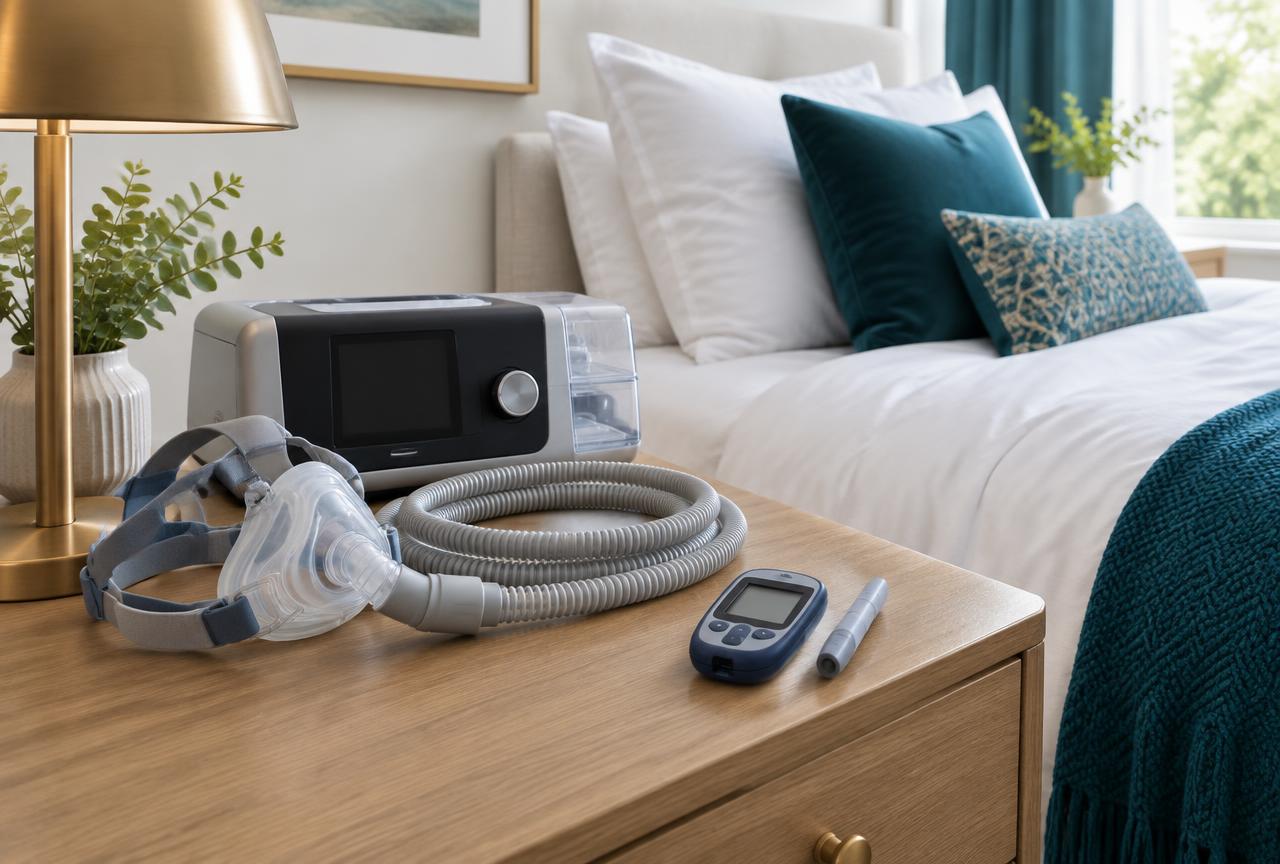
Obstructive sleep apnoea and type 2 diabetes occur together far more often than chance would predict, and the overlap is frequently unexamined. People are treated for years for glucose, weight and blood pressure without anyone asking how they sleep, and the symptoms that would prompt the question are easy to attribute to something else.
The relationship appears to run in both directions, which makes it a reasonable thing to screen for in a metabolic clinic. What treatment does for glucose control, however, is a more complicated story than it is often made to sound, and it is worth setting out honestly.
How common the overlap is
Reported prevalence varies widely with the population studied and the testing method. A review in European Endocrinology summarising epidemiological studies found moderate-to-severe obstructive sleep apnoea in 23.8 to 70 per cent of people with type 2 diabetes, against general-population estimates of roughly 9 to 14 per cent of men and 2 to 7 per cent of women. Lower figures came from primary care samples, higher ones from secondary care.
In the Sleep AHEAD cohort, 305 overweight and obese adults with type 2 diabetes underwent home sleep studies, and 86 per cent had an apnoea-hypopnoea index of 5 or more. That is a selected group and not a general estimate, but it indicates how high the figure can go where obesity and diabetes coexist.
Looking the other way, a review in Chest estimated that 15 to 30 per cent of people with obstructive sleep apnoea have type 2 diabetes, with higher rates in severe apnoea. Much of that association is attenuated when BMI and other confounders are accounted for, which is a reminder that obesity contributes substantially to both.
The bidirectional mechanism
The proposed pathways from apnoea to disordered glucose metabolism are reasonably well characterised:
- Repeated cycles of oxygen desaturation and reoxygenation generate oxidative stress. In healthy volunteers, a few hours of intermittent hypoxia has been shown to reduce insulin sensitivity without a compensatory rise in insulin secretion.
- Recurrent arousals and hypoxia increase sympathetic nervous activity, which affects both insulin secretion and hepatic glucose output.
- Sleep fragmentation and loss of slow-wave sleep are themselves associated with lower insulin sensitivity.
- Apnoea alters adipokine and inflammatory signalling, lowering adiponectin and raising inflammatory cytokines.
A meta-analysis found that moderate-to-severe obstructive sleep apnoea was associated with incident type 2 diabetes with a relative risk of 1.63; for mild apnoea the association was not statistically significant.
The reverse direction is less established but plausible. Diabetic autonomic and peripheral neuropathy may impair central respiratory control and upper airway reflexes, and in people with type 1 diabetes those with apnoea had higher rates of autonomic and peripheral neuropathy. This remains an association rather than a demonstrated causal mechanism.
Why it is frequently missed
Snoring is normalised. Daytime tiredness in someone with obesity and diabetes is attributed to the diabetes, to low mood, or to being busy. Nocturia is attributed to glucose. Morning headache is attributed to sleep quality in a circular way. And the classic picture of a sleepy middle-aged man is a poor guide: women, people who are not markedly sleepy, and people of lower body weight all have apnoea and are diagnosed later.
NICE lists type 2 diabetes among the risk factors that should prompt assessment for obstructive sleep apnoea-hypopnoea syndrome, alongside obesity, treatment-resistant hypertension, atrial fibrillation, previous stroke or transient ischaemic attack, heart failure, polycystic ovary syndrome, hypothyroidism and acromegaly. The features it lists as suggesting the condition include snoring, witnessed apnoeas, unrefreshing sleep, waking headaches, excessive sleepiness or fatigue, nocturia, choking during sleep, sleep fragmentation and cognitive or memory difficulty.
What assessment involves
Assessment begins with the history, including an account from a bed partner where possible. NICE advises using the Epworth Sleepiness Scale but not on its own to determine referral, and suggests considering the STOP-Bang questionnaire alongside the sleep history. Questionnaires identify who should be tested; they do not diagnose.
Diagnosis requires a sleep study. NICE recommends offering home respiratory polygraphy first, with home oximetry considered where access to polygraphy is limited. If oximetry is negative but symptoms are significant, respiratory polygraphy or polysomnography can be considered, and polysomnography is reserved for cases where polygraphy is negative but symptoms persist. Severity is graded from the sleep study result.
What treating it does, and does not do
For symptoms, treatment can be transformative, and NICE recommends continuous positive airway pressure for moderate or severe disease and for mild disease where symptoms affect quality of life and daytime activities. Mandibular advancement splints, positional modifiers and surgical assessment have defined roles where CPAP is declined or not tolerated.
For glucose control, the evidence is weaker than the mechanism predicts, and this is where overstatement is common. A review in Chest summarised seven controlled studies in type 2 diabetes with 498 participants. Of the four reporting HbA1c at three to six months, three found no significant reduction, including the largest with 256 completers. One found a reduction of around 0.4 per cent, and another a similar reduction only after excluding dropouts and medication changes. An earlier meta-analysis found no significant effect on HbA1c. In the Sleep AHEAD trial of intensive lifestyle modification, weight loss of 10.8 kg reduced the apnoea-hypopnoea index and lowered HbA1c, but the change in HbA1c was not related to the change in apnoea severity.
The honest summary is that CPAP has not been shown to produce a reliable improvement in HbA1c in people with type 2 diabetes. Adherence appears to matter, and benefit may be greater in those with poorer baseline control, but it should be regarded as adjunctive. Treat apnoea because it causes sleepiness, impairs quality of life and carries cardiovascular and driving risk, not on the promise of a better HbA1c.
That is still a strong reason to look for it. If you snore, wake unrefreshed, or your partner has noticed you stop breathing, raise it at your next diabetes review.
Sources & further reading
- NICE NG202: assessment for OSAHS — risk factors (including type 2 diabetes), Epworth and STOP-Bang
- NICE NG202: OSAHS investigations and treatment — respiratory polygraphy, oximetry, polysomnography and CPAP
- Reutrakul and Mokhlesi, Chest (2017): obstructive sleep apnea and diabetes — a state of the art review
- Tahrani and Ali, European Endocrinology (2014): obstructive sleep apnoea and type 2 diabetes
- Sleep AHEAD Research Group, Sleep (2012): sleep apnoea prevalence in overweight and obese adults with type 2 diabetes

Reviewed by
Dr Chinnadorai Rajeswaran
Specialist Endocrinologist · MBBS MRCP FRCP
Last Reviewed: November 2026
Read about diabetes and related care.
Related insights
Type 2 Diabetes and Weight: What Remission Really Means
Type 2 diabetes remission means glucose levels below the diabetes range without glucose-lowering medication for a sustained period; it is not a cure, and diabetes can return. Weight loss can support remission for some people, especially earlier in the condition, but medication changes and ongoing HbA1c monitoring should be clinician-supervised.

Do artificial sweeteners affect insulin sensitivity?
Evidence does not show that non-sugar sweeteners as a group uniformly impair insulin sensitivity or cause obesity; effects and long-term evidence vary. Replacing sugary drinks with low- or no-calorie alternatives may reduce sugar intake, but this is not a guaranteed health outcome and water is also an option.

What Insulin Resistance Actually Is, and How It Is Assessed
Insulin resistance is a physiological mechanism rather than a diagnosis, and the UK has no routine clinical test that confirms or excludes it. Treat an "insulin resistance score" as one piece of information, not a label, and have it read alongside your HbA1c, lipids, liver tests and waist measurement before any treatment is started on the strength of it.