The Dawn Phenomenon: Why Morning Glucose Can Be Highest
Quick answer
A rise in glucose in the hours before waking is normal physiology driven by cortisol, growth hormone and other counter-regulatory hormones, and in type 2 diabetes it contributes roughly 4 mmol/mol, about 0.4 per cent, to HbA1c. A high morning reading does not by itself mean poor control or too little evening medication, so record the pattern over several nights and do not change insulin or other glucose-lowering doses without clinician review.
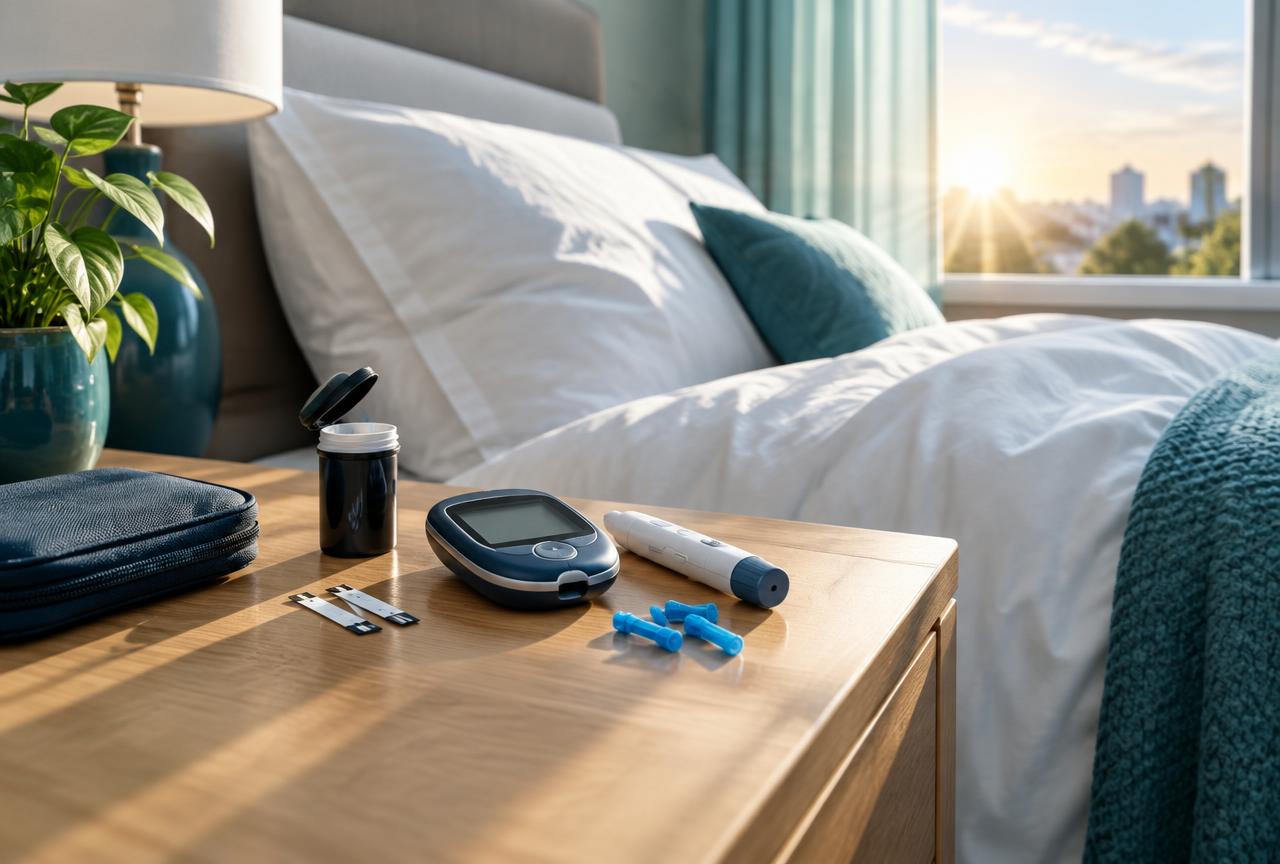
A common and reasonable complaint is that fasting glucose is the highest reading of the day, despite nothing having been eaten for ten hours. It feels like a contradiction, and it is often interpreted as evidence that something has gone wrong overnight.
Usually it has not. The rise in glucose in the hours before waking is a normal part of human physiology, driven by hormones that follow a daily rhythm. In people with diabetes the rise is larger, because the insulin response that would otherwise offset it is blunted. This is the dawn phenomenon.
Understanding it changes how morning readings should be read, and prevents a particular kind of mistake: increasing evening medication to chase a number that is not caused by the evening.
The hormonal mechanism
Several counter-regulatory hormones, which oppose the action of insulin, rise in a circadian pattern during the second half of the night. Growth hormone is secreted in pulses during sleep. Cortisol rises from a nocturnal trough towards an early-morning peak. Catecholamines and glucagon contribute.
Together these increase glucose production by the liver and reduce glucose uptake by peripheral tissues. The surge is usually placed in the predawn hours, roughly between 3 and 8 am. In a person with intact insulin secretion, the pancreas releases more insulin and the net effect on blood glucose is modest. Where insulin secretion or insulin sensitivity is impaired, the compensation is incomplete and glucose rises.
The purpose is not pathological: the body is preparing to be awake and active after an overnight fast. In diabetes the braking mechanism is simply weaker than the accelerator.
How large an effect it is
Research using continuous glucose monitoring gives a reasonably consistent picture, at least in type 2 diabetes not treated with insulin.
In a study of 248 adults with type 2 diabetes on diet alone or on oral treatment, the median rise from the overnight glucose low to the pre-breakfast value was 16 mg/dl, with an interquartile range from 0 to 31.5 mg/dl, roughly 0.9 mmol/l with a range from 0 to 1.8. Comparing those with and without a dawn rise, matched for their overnight low, the difference in 24-hour mean glucose corresponded to about 4.3 mmol/mol of HbA1c, or 0.39 per cent.
A separate study of 81 adults with type 2 diabetes, grouped by age, found mean rises of around 18 to 22 mg/dl, approximately 1.0 to 1.2 mmol/l, with prevalence between 52 and 70 per cent depending on age group and definition, and no statistically significant difference between age groups.
Two things follow. The dawn phenomenon is common, affecting roughly half to two-thirds of people with type 2 diabetes in these cohorts. And its contribution to overall glucose exposure is real but modest: enough to matter when HbA1c sits near a threshold, not enough to explain a large discrepancy on its own.
How it differs from the Somogyi effect
The Somogyi effect, sometimes called rebound hyperglycaemia, proposes that an episode of hypoglycaemia overnight triggers a counter-regulatory response that overshoots, producing high glucose by morning. The implication is the opposite of intuition: morning highs would mean too much insulin at night, not too little.
The two are distinguished by what happens in the middle of the night. The dawn phenomenon occurs without preceding nocturnal hypoglycaemia; the Somogyi effect, by definition, requires it. Continuous glucose monitoring, or failing that a reading between 2 and 3 am, is how the distinction is made.
Whether the Somogyi effect is real has been questioned for decades. A retrospective analysis of continuous glucose monitoring data from 2,600 adults with type 2 diabetes on stable insulin treatment, covering 4,705 nights, found the opposite of what the hypothesis predicts: morning fasting glucose was lower after nights with hypoglycaemia than after nights without it, and fasting glucose correlated positively with the overnight glucose low. The authors concluded that their data provided no support for the existence of the Somogyi effect.
Clinical reference sources still list it as a differential diagnosis, and it would be overstating the case to say it never occurs in any individual. But the weight of monitoring evidence does not support it as a common explanation for morning hyperglycaemia, and nocturnal hypoglycaemia is a reason to reduce overnight insulin in its own right, whatever happens to the morning reading.
Why it matters for interpreting readings
A high fasting glucose has several possible explanations, and they lead to different actions:
- A dawn rise from a reasonable overnight starting point, which is physiological
- A glucose level that was already high before bed and never came down
- Insufficient overnight basal insulin in someone treated with insulin
- Nocturnal hypoglycaemia, which matters regardless of the morning value
- A late or large evening meal, alcohol, illness, poor sleep or untreated sleep apnoea
A single morning reading cannot separate these. A pattern over several nights, ideally with some information about what glucose did between midnight and waking, usually can.
What it does and does not mean about control
A raised fasting glucose caused by the dawn phenomenon is not evidence of failure, and it is not evidence that overall control is poor. HbA1c reflects the whole 24 hours, and post-meal glucose contributes substantially to it. Judging control from the morning reading alone will mislead in both directions.
NICE does not recommend routine self-monitoring of capillary glucose for adults with type 2 diabetes unless they are on insulin, there is evidence of hypoglycaemic episodes, they are taking oral medication that could cause hypoglycaemia while driving or operating machinery, or they are pregnant or planning pregnancy. If you are monitoring, record the pattern rather than reacting to single values.
Most importantly, do not change the dose or timing of insulin or any glucose-lowering medicine on the basis of morning readings without discussing it with your clinician. The same high fasting number can require an increase or a decrease depending on what happened overnight, and guessing in the wrong direction carries real risk.
Sources & further reading
- Monnier et al., Diabetes Care (2013): magnitude of the dawn phenomenon and its impact on overall glucose exposure in type 2 diabetes
- Diabetes Care (2012): frequency and severity of the dawn phenomenon in type 2 diabetes
- StatPearls, NCBI Bookshelf: dawn phenomenon — mechanism and distinction from the Somogyi effect
- Huang et al., International Journal of Endocrinology (2022): absence of the Somogyi effect in type 2 diabetes on retrospective continuous glucose monitoring
- NICE NG28: type 2 diabetes in adults — self-monitoring of capillary blood glucose

Reviewed by
Dr Chinnadorai Rajeswaran
Specialist Endocrinologist · MBBS MRCP FRCP
Last Reviewed: November 2026
Read about diabetes and related care.
Related insights
Type 2 Diabetes and Weight: What Remission Really Means
Type 2 diabetes remission means glucose levels below the diabetes range without glucose-lowering medication for a sustained period; it is not a cure, and diabetes can return. Weight loss can support remission for some people, especially earlier in the condition, but medication changes and ongoing HbA1c monitoring should be clinician-supervised.

Do artificial sweeteners affect insulin sensitivity?
Evidence does not show that non-sugar sweeteners as a group uniformly impair insulin sensitivity or cause obesity; effects and long-term evidence vary. Replacing sugary drinks with low- or no-calorie alternatives may reduce sugar intake, but this is not a guaranteed health outcome and water is also an option.

What Insulin Resistance Actually Is, and How It Is Assessed
Insulin resistance is a physiological mechanism rather than a diagnosis, and the UK has no routine clinical test that confirms or excludes it. Treat an "insulin resistance score" as one piece of information, not a label, and have it read alongside your HbA1c, lipids, liver tests and waist measurement before any treatment is started on the strength of it.